The first 180 days
Mobilisation is where documented design becomes operating reality. It is bounded in time and has a defined outcome: the function is operating at design specification by the close of mobilisation. Activities that extend beyond mobilisation belong to Stage 5. Mobilisation is not perpetual.
I have come to think of the first 180 days as the most disproportionately consequential six months in a function’s life. The behaviours and patterns established here become extraordinarily difficult to change later. A function that develops bad habits in mobilisation will carry those habits for years. A function that establishes good habits inherits them as routine. Get the mobilisation right and the function inherits good habits; get it wrong and the function inherits the same bad habits the methodology was designed to prevent.
Mobilisation also serves as the first practical test of the design. Where the design is sound, mobilisation reveals this through smooth establishment of operating rhythm. Where the design has weaknesses, mobilisation surfaces them, usually as friction, missed deadlines, or unclear accountabilities. Either way, the information is valuable.
Three principles
Three principles govern effective mobilisation. They are stated simply but require active discipline to maintain under pressure.
Sequence by dependency, not by convenience. Some activities must precede others. Governance before decisions, team before delegation, reporting structure before reporting. The temptation to parallelise everything in the interest of speed produces an apparently busy mobilisation that is in fact disorganised, with later activities undermined by earlier ones that were not properly completed.
Resist the temptation to re-design. Mobilisation tests the design but does not rewrite it. If a design choice proves genuinely wrong, it is corrected through formal change control with sponsor approval — not informally adjusted by operators encountering it for the first time. Informal in-flight redesign undermines every subsequent decision.
Track to the design, not to opinion. Mobilisation success is measured against the approved design, not against emerging preferences. The design is the contract between the function and its sponsor. Departure from it is a breach to be negotiated, not a discretion to be exercised.
The 180-day milestones
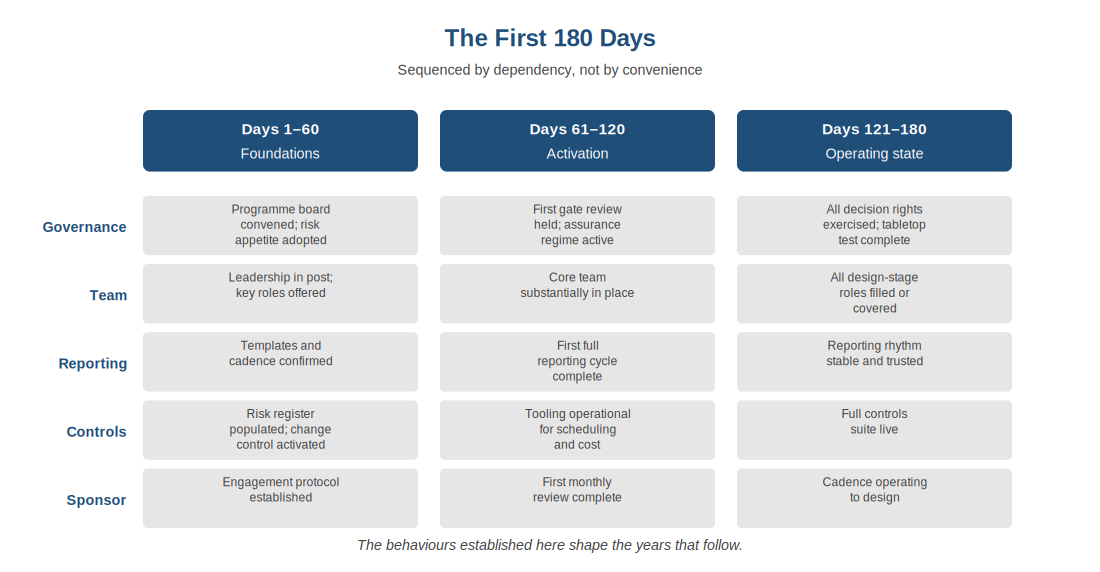
I think about the timeline in three phases of 60 days each. Each phase has its own character, its own milestones across governance, team, reporting, controls, and sponsor engagement, and its own failure modes.
Days 1–60: Foundations
The first 60 days establish the foundations on which the rest of mobilisation depends. The work is concentrated on governance activation, leadership in post, and the establishment of the protocols and templates that everything else uses.
Key activities: sponsor engagement protocol established and operating; programme board convened for its first formal meeting with terms of reference and agenda; risk appetite formally adopted by the board; initial team members onboarded against the role specifications from the Design stage; communications cascade activated to ensure internal awareness; reporting templates and cadences confirmed and issued; first risk register populated; initial assurance regime activated with named assurance leads.
The most common failure I see in the first 60 days is mistaking activity for progress. A flurry of meetings and document issuance can produce the appearance of mobilisation without the substance. The test is whether the foundational decisions have actually been taken and whether the operating mechanisms are actually operating — not whether the function has been seen to be busy.
Days 61–120: Activation
By day 120, foundations established in the first 60 days should be operating, and the team and capability should be substantially in place. This is the phase where the function transitions from being established to being operational.
Key activities: core team substantially in post against each design-stage role; process framework deployed in working form, not just documented form; tooling operational for the key controls (scheduling, cost management, document control); first gate review held — typically a project initiation gate or equivalent — with formal sponsor and board engagement; stakeholder map confirmed and engagement begun; commercial baseline confirmed for Buy and Hybrid paths; first lessons-identified cycle conducted on the mobilisation itself.
The 120-day mark is the first natural review point. A formal mobilisation progress review at this point — attended by the sponsor and chaired by the Programme Director — surfaces issues while there is still time to correct them. Reviews delayed until day 180 frequently identify problems that should have been addressed earlier.
Days 121–180: Operating state
By day 180, mobilisation should be complete and the function should be in operating state. All design-stage roles are filled or have interim cover, all controls are active, the reporting rhythm is stable, and the board has confidence in the function’s operation.
Key activities: all design-stage roles in post or with interim cover defined; full reporting rhythm operating with no schedule slippage; all design-stage controls active and producing data; first independent assurance review complete with findings addressed or actioned; board confidence in function operation confirmed through formal sponsor reporting; mobilisation close-out review held with documented findings; transition to Sustain confirmed.
Mobilisation closure is a formal milestone, not a drift. It requires a written close-out report signed by the sponsor confirming that the function is operating at design specification, that any deviations have been formally noted and accepted, and that responsibility transitions from the mobilisation team to the operating function. “We’ll declare it done when it feels done” is not closure. It is the absence of closure.
Governance, exercised in practice
The most common mobilisation failure I see is governance that exists on paper but does not function in practice. Activation is more than convening meetings. It includes confirming that decision authority is exercised correctly, that escalation actually escalates, that risk appetite is applied in practice, and that the sponsor’s mandate is visible in observable behaviour.
Tabletop exercises during the first 60 days test governance under simulated stress. A scenario — a major cost overrun, a key personnel departure, a contractual dispute — is presented to the board and the response is observed. Weaknesses in decision rights, escalation routes, or risk appetite surface here where they can still be corrected without operational consequences. Doing this once at day 30 has, in my experience, saved more programmes than any other single mobilisation activity.
Mobilisation risk is its own thing
Mobilisation is risk-rich by nature. The function is least capable when most needs to be done. New processes are untested. The team is new to one another. Stakeholders are still calibrating their relationships with the function. The risk profile during mobilisation is materially different from the risk profile during steady-state operation.
Keep a mobilisation-specific risk register, separate from the programme risk register. Mobilisation risks are about the function’s establishment (recruitment slippage, tooling delays, governance traction); programme risks are about the work being delivered. Mixing them obscures both. Review the mobilisation risk register weekly during mobilisation; review programme risks at the standing programme cadence. By day 180, close out the mobilisation risk register and transfer any surviving items to the programme risk register or the function’s permanent operational register.
Four ways mobilisation fails
In my experience, mobilisation fails in one of four characteristic patterns. Recognising them early allows correction before they become embedded.
Over-mobilisation. Trying to do everything in the first 60 days. The team is exhausted by day 45, the most important foundational work has not received the focus it requires, and the function loses momentum just when momentum is most needed. Sequence matters more than parallel effort.
Under-mobilisation. Treating mobilisation as a planning exercise rather than an activation exercise. Reports, plans, and templates proliferate but actual operation does not begin. By day 180 the function has a complete document set but has not yet held a real decision-making meeting. Mobilisation requires doing, not just preparing.
Premature stabilisation. Declaring the function operational before it actually is, usually under board pressure to show progress. The close-out report signs off a function that in fact is not yet capable, and operational problems emerge in the months that follow. The discipline is to declare operating state only when it has actually been achieved, even if that means extending mobilisation past day 180 with a documented variance.
Re-design under pressure. Revisiting Design choices when they prove inconvenient in mobilisation. This is the most damaging failure mode, because it undermines the entire methodology. If design is negotiable in mobilisation, design has no force. Route change through formal change control, or do not change.
How it’s led
Mobilisation is led by the appointed Programme Director or interim equivalent, with the sponsor providing executive cover and board interface. The lead is accountable for delivering the mobilisation outcome. The sponsor is accountable for protecting mobilisation from external pressures that would otherwise force compromises.
Independent advisory support during mobilisation is valuable. An external adviser can see governance weaknesses that the operating team cannot and can flag mobilisation failure modes before they become entrenched. The adviser’s role ends at mobilisation closure unless explicitly extended.
Mobilisation closure is the formal handoff into Sustain. The close-out report includes: confirmation that the function operates to design specification; any variances formally documented and accepted; a transition plan from mobilisation team to permanent operating team where these differ; and the first scheduled review point under Sustain.
• • •