Capability for the long term
Sustain is the longest-running stage in the methodology. It begins at the close of mobilisation and continues for as long as the function exists. Its purpose is to sustain the function in operating condition, maintain capability through use and renewal, periodically reassess whether the chosen delivery model remains the right one, and feed lessons back into the function and into future programmes.
Sustain is what completes the methodology cycle. Without it, every PM function regresses. Documentation drifts out of currency. People leave and are replaced by people unfamiliar with the original design intent. Tools fall behind. Maturity that scored high in year three may be measurably lower in year five if no deliberate sustainment is in place.
Sustain is distinct from the work the function performs on programmes. It is the work the organisation performs on the function. Programmes come and go; the function persists, and persistence requires deliberate maintenance.
Why functions decay
Without active sustainment, a PM function decays through a predictable sequence.
Documentation falls out of step with practice. New joiners learn from the practice rather than the documentation, so the practice becomes the new standard regardless of design intent. Lessons captured at programme close are filed but not embedded. Tools cease to be upgraded. Within five years, the function bears only a passing resemblance to its design, and no one can recall exactly when each drift occurred.
Active sustainment prevents this decay through scheduled activity rather than reactive correction. The cost of sustainment is real but predictable. The cost of non-sustainment is also real, but unpredictable, and almost always higher.
Four principles
Four principles govern effective sustainment.
Capability is maintained through use, not through declaration. A function that is not exercised loses capability faster than one that is exercised — even badly. The implication is that periods of low programme activity require deliberate substitute activity (pilot projects, internal advisory work, sector engagement) rather than acceptance of dormancy.
Lessons are valuable only if they change subsequent behaviour. Lessons captured and filed are not lessons. They are records. Lessons embedded in process, tooling, or culture are real and are learned. Track not just whether lessons are captured but whether they have actually changed how the function operates.
The function’s design is itself subject to review. What was right at inception may not be right five years on. Markets change, the organisation changes, the wider programme management discipline evolves. A design that is preserved exactly as originally specified for a decade is unlikely to remain optimal across that span.
Reassessment is scheduled, not triggered. Waiting for failure as the trigger for reassessment is too late. The cadence of reassessment is built into the methodology and adhered to as discipline, not adjusted in response to immediate conditions.
Operational rhythm
Effective sustainment runs on a defined operational rhythm, with activities aligned to appropriate cadences.
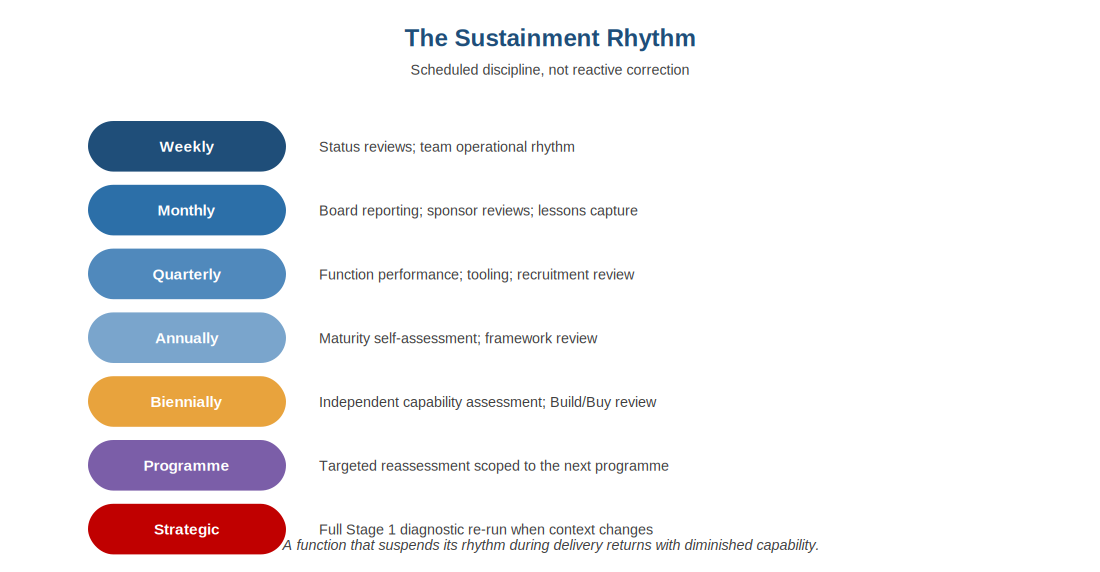
The rhythm is maintained as a discipline regardless of programme activity. A function that suspends its sustainment rhythm during programme delivery returns to the rhythm later with diminished capability and weakened habits — which is exactly the opposite of what sustainment is intended to produce.
Capability maintenance across the five domains
Capability maintenance covers each of the five operating domains of the function. Each has its own regime.
People. Continuing professional development against role-specific accreditation requirements; succession planning for key roles with named potential successors; periodic role specification refresh as roles evolve; structured exit interviews with leavers to capture institutional knowledge before it departs.
Process. Framework review at the documented cadence with lessons embedded into updated procedures; piloting of significant changes before broad deployment; version control with formal change history; periodic comparison of documented process against actual practice to surface drift.
Tools. Version management with upgrade decisions taken deliberately rather than deferred; integration health monitoring between tools; training renewal for users when versions change; periodic comparison of tool capability against current practice needs.
Governance. Terms of reference reviewed annually; decision rights confirmed at each board refresh; risk appetite revisited when strategic context changes; periodic test of governance under tabletop scenarios to confirm it still functions in stress conditions.
Culture. Behavioural indicators tracked (speed of escalation, accuracy of reports, retention of programme staff); executive role-modelling maintained through visible engagement; first instances of cultural drift addressed promptly rather than tolerated. Culture is the slowest-changing domain in either direction. The drift takes years; the recovery, longer.
Periodic reassessment
Reassessment occurs at four scheduled points, plus a strategic trigger condition.
Annual maturity self-assessment. The function assesses itself against the baseline established at maturity assessment in earlier stages. This is the most frequent reassessment and the lowest cost. Its purpose is to surface trends — improving, stable, or regressing — so that targeted intervention can occur before the biennial independent assessment becomes the surprise event.
Biennial independent reassessment. Every two years, the function commissions an independent assessor — using the same protocol as the original Stage 1 diagnostic — to assess current maturity against the baseline. This is the most reliable indicator of actual capability state and the most resistant to internal self-deception. Findings drive the function’s improvement plan for the following two years.
Programme gateway reassessment. At each major programme gateway, a targeted reassessment is conducted scoped to the specific characteristics of the next programme. The question is not ‘is the function generally mature’ but ‘is the function ready for this specific programme’. The two questions can have different answers.
Strategic trigger. When corporate strategy changes materially — major reorganisation, new strategic direction, acquisition or divestment, change of CEO with corresponding executive turnover — a full Stage 1 diagnostic is re-run. The strategic context within which the function was originally designed has changed, and the design must be re-tested against the new context.
Programme closure and capability legacy
Each major programme should produce capability legacy beyond the programme outputs themselves: lessons documented, individuals developed, processes refined, tools improved, partner relationships strengthened or formally concluded.
An organisation that closes programmes without harvesting legacy is paying full price for delivery and receiving only the deliverables. The legacy is the institutional return on investment: the capability the function gains, the people it develops, the lessons it learns. Capturing it requires deliberate effort. Allowing it to dissipate requires no effort at all and is therefore the default outcome unless actively prevented.
Programme closure protocols should include a structured handover from programme team to function; documented lessons-identified with named owners for embedding; capability uplift assessment for embedded staff; partner performance review with documented outcomes informing future procurement; and archive of programme data, decisions, and rationale in a form retrievable later.
Reassessing Build, Buy, Hybrid
The decision from Chapter 2 is revisited under specific conditions: at programme gateways, every 24 months as part of the biennial assessment, when capability assessment indicates readiness for transition between modes, or when strategic context changes materially.
The trigger is the question, not the answer. Triggers do not pre-determine the conclusion — they ensure the conclusion is reached deliberately rather than by drift. A Hybrid arrangement that has been in place for five years without ever being formally re-examined has become permanent by default, not by decision. The reassessment exists to surface whether continuation is the right choice or merely the path of least resistance.
Reassessment outcomes may include: continue with the current model unchanged; transition between modes; refresh the current model’s design while retaining the model itself; or commission a full Design redesign. Each outcome is documented with rationale, so that subsequent reassessments have a clear baseline to test against.
Closing the loop
The Owner’s Team Methodology is a cycle, not a one-time linear progression. Sustain feeds back into Diagnose. Lessons captured here inform the diagnostic frameworks used in Chapter 1. Function evolution drives refinement of operating models, contracts, and processes used in subsequent Design exercises.
The methodology is, ultimately, a framework for continuous organisational capability development of which any single programme is only one expression. The function exists not just to deliver programmes but to ensure that the organisation is capable of delivering the next one, and the one after that, with the lessons of every prior programme embedded in its practice.
This is what distinguishes a sustained capability from a serial set of project-specific arrangements. A sustained capability accumulates competence. A serial arrangement merely accumulates experience and forgets it as the people move on. The discipline of Sustain is what makes the difference between the two.